Use the power of storytelling in tech to get promoted faster
Communication techniques that build your executive presence
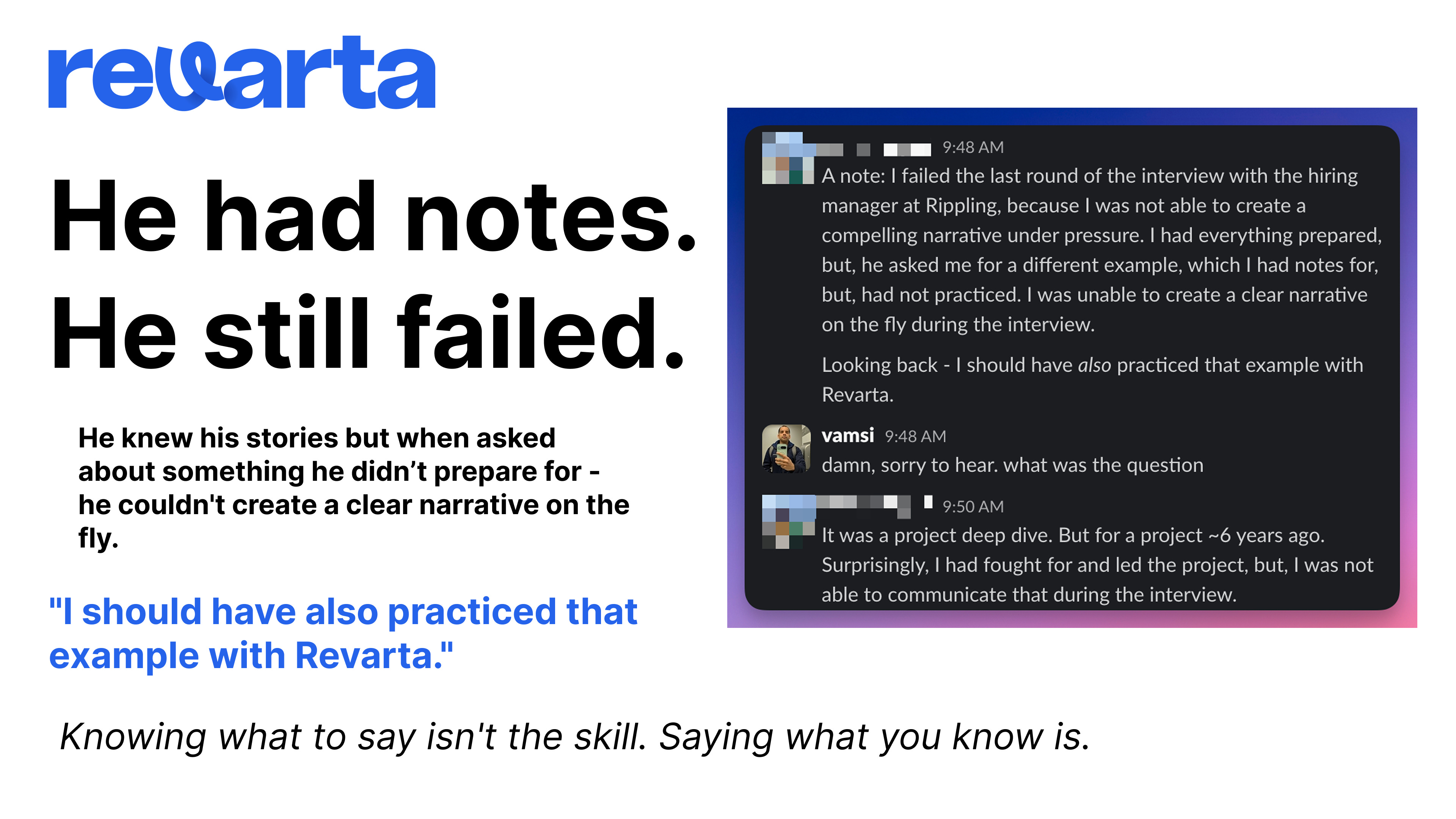
đŁ âHe Had Notes. He Still Failed.â (Sponsor)
You know your interview stories. But can you tell them clearly under pressure?
Most engineers prep by writing notes. But writing isnât practice. Revarta gives you live audio interviews with follow-up questions and feedback on whatâs actually landing.
Built by a hiring manager with 1,000+ interviews at Amazon and Google.
Hi fellow High Growth Engineer, Jordan here đ
Today, we have a unique guest, Mark Bayer, ex-U.S. Senate Chief of Staff and strategic communications expert. As you can imagine, being in politics requires a particular set of skills. Storytelling is one of the most important. Storytelling skills are incredibly important everywhere, but especially in tech as you move to higher levels. The job will increasingly be about convincing others of your ideas on a larger and larger scale. Storytelling does just that.
Before we jump in, Iâm sharing Markâs links so they donât get lost. Hereâs his one-page storytelling resource, free how-to video on storytelling he did for Cornell, and his LinkedIn where he welcomes any outreach.
So without further ado, Iâll pass the mic đ¤ to Mark đ
Storytelling makes you stand out
Itâs the final round interview for my first job on Capitol Hill. Iâm meeting with the Congressman in his officeâ15-foot ceilings, framed pictures of famous people, a map of the world covering an entire wall.
Heâs not interested in my academic credentials or my writing skills. âTell me a joke,â he says. âJust tell me a joke.â I donât remember anything after that, but I got the job. And that job launched my career in Congress, where I served as a Chief of Staff in the U.S. Senate, helping to shape laws that made a difference for millions of Americans, participating in major events at the White House, and meeting some of the worldâs most interesting people.
â What youâll learn in this article
Youâll discover how to use one of the most powerful, proven, and efficient tools to demonstrate qualities that get you into leadershipâlikeability, relatability, and executive presence.
Youâll see how stories use emotion to influence how your listeners feel, a vital input to decision-making thatâs different from logical reasoning. And youâll get a straightforward, proven storytelling model to connect with your stakeholders on a deeper human level, which only communicating data canât achieve, so you can get promoted faster.
When to use storytelling
There are two main use cases in work environments:
Building your presentations. Apply the storytelling structure and techniques in this post to demonstrate next-level writing and presentation skills when youâre responding to business questions or trying to get buy-in for your ideas.
During job interviews and promotion discussions. Storytelling breathes life into examples of times youâve shown executive-level attributes, like system-level thinking, cross-functional communication, and delivering feedback. It can also be used to illustrate personal qualities that get you promoted, like times youâve overcome obstacles and navigated changes at key points in your life.
Strong stories use a similar structure
Stories that have the biggest impact on decision-makers follow a common structure.
TheyâŚ
Grab attention immediately with a short first sentence.
Delete any detail that isnât directly relevant to stakeholder priorities.
Use rhetorical tools to introduce new information, like comparing it to familiar topics or situations.
They follow a format that looks similar to this one:
Buying licenses for X would be a mistake. We already have similar functionality with our platform. It would be like wearing glasses over your contacts. And the benefits would be minimal, but the cost of implementing X would swallow half of next yearâs training budget. So I recommend we take a pass and focus on high-priority bug fixes instead.
Now, letâs look at a story on the same topic that falls into some common storytelling traps.
Buying licenses for X would consume significant resources, so I talked to 10 of Xâs clients to see whether it would make sense for us to add it to our stack. I also spent time comparing it to our system and found some functionality that would be an improvement. For example, weâve been having issues with errors around A, B, and C, and it seems like X would be more effective there but not necessarily significantly better. Given the sizable investment, we should do a deeper cost-benefit analysis, like thoroughly costing out the total spend to implement before making a final decision.
Where are the major weaknesses in the second version of the story?
It leads with process steps. This is a common mistake. It wastes the first few seconds, when listeners decide whether to pay attention, on a behind-the-scenes process thatâs not immediately relevant.
Sentences are too long. Compact sentences are easier for listeners to process.
Thereâs no clear recommendation. Without a specific recommendation, the story essentially puts the burden back on the decision-maker.
4S Framework: How to craft your own high-impact stories to get to the next level
To quickly develop strong stories like the first version, I created the â4S storytelling framework.â You can use it to leverage storytellingâs power while avoiding pitfalls.
Itâs an easy-to-apply model that reflects what we know actually works, from centuries-old stories that still influence how we feel, think, and behave to todayâs discoveries in neuroscience.
Here are the 4 specific elements of the framework and how to use them effectively.
S1: Substance
đĄMain Takeaway: âItâs not just what you know. Itâs what they need to know.â
Substance is what to tell your story about. Start here. To determine your topic, ask yourself this question:
Thinking about my listenerâs most important priorities right now, which ones can I confidently move towards a positive result?
You could use a Venn diagram like this one to help decide your story content. Pick a topic inside the âImpact Zoneâ.
Stories that have the biggest impact on your decision-makers are about their most pressing challenges and showcase your ability to directly and successfully address them.
If you tell a story about how to solve a problem far down your stakeholdersâ to-do list or outside their area of responsibility, theyâll tune out. Youâre wasting their time.
If your story focuses on one of their top goals, but youâre not really that knowledgeable about how specifically to achieve it, a strong story wonât demonstrate your promotion potential. It may actually diminish it.
In the second story version from the prior section, itâs clear the storyteller isnât confident (or maybe qualified) to make a specific, actionable recommendation that responds directly to the pressing licensing question.
You can think about how your storyâs substance influences your stakeholdersâ assessment of your promotion potential like this:
S2: Surplus
đĄMain Takeaway: âThe devil isnât in the details; the devil is the details.â
Surplus is the material to leave out of your stories.
Surplus details include data not directly tied to answering the specific question youâve been asked. Often, you unnecessarily include process steps, or what you did to arrive at your conclusion. These details are not immediately important to decision-makers in an industry environment. They may ultimately want to know, but leading with them risks losing your listeners at the start before you get to their priorities.
Hereâs an example from everyday life:
Youâre having friends over, and your place is a mess. Your partner asks you to clean the kitchen before the guests arrive. You go into the kitchen, and thereâs stuff everywhere: dirty dishes piled in the sink, pots and pans that need to be put away, crumbs everywhere. You get to work. A half-hour later, youâre finally done. When you find your partner setting out the drinks, you want to share everything you had to do to get the kitchen in shape. You want to tell them about the dog hair you needed to vacuum off the floor, how dirty the countertops were, and those stains on the wall you had to scrub off. The thing is, your partner doesnât really care. They only want to know one thing: Is the kitchen clean?
When youâre crafting your story and trying to decide whether to include or leave out various pieces, ask yourself:
Is this information directly relevant to listenersâ priorities?
Do listeners need this detail to understand the point of the story?
Am I including this information only because I think itâs interesting or because I worked hard on it?
Humans are hard-wired to shift attention away from irrelevant information. We are conditioned to conserve energy for what matters most to us.
Remembering Surplus helps you zero in first on addressing listenersâ strategic needs and leaving out the rest.
S3: Sequence
đĄMain Takeaway: âDonât get to the point, start at the point.â
Sequence is the order of sections in your story and the job of each section. The following guiding principle will help you determine the most impactful order for presenting the substance of your story:
Compelling stories and presentations immediately grab listenersâ attention. Thereâs no lengthy setup. They donât follow a linear, logical progression. They create tension by being unpredictable. Specifically, when you lead by directly addressing your listenersâ priority (âBuying licenses for X would be a mistakeâ in the first example above), you immediately capture their attention. At the same time, youâre not revealing the entire story, such as evidence backing up your position. Listeners want to know: âWhatâs the evidence?â The gap between what youâve revealed and the evidence supporting it is called an âopen loop.â The open loop sparks listenersâ curiosity, so they pay attention because they want to âclose the loop.â They want the remaining information to understand the evidence supporting your recommendation.
For comparison, letâs look at a common presentation sequence and why it fails to capture and keep listenersâ attention.
Following this linear progression, you can imagine the presenter walking through:
Why weâre here
What we did
What we found
Why itâs important
What we found (recap)
The first two parts of this 5-part presentation set the stage. The first section is obvious to attendees. The second is behind-the-scenes information and, consequently, not as immediately relevant to decision-makers. If each of these parts consumed roughly the same amount of time, 40 percent of the presentation would be over before we shared the most important content, the results.
Listeners instantly assess whether to pay attention. They quickly tune out when presentations are slow to deliver new information for solving their pressing problems.
Here are two key human tendencies that will tell us how we change our progression:
Tension attracts attention. When a story or presentation begins by highlighting a challenge and how to overcome it, weâre all ears. Thatâs because, for survival, weâve been programmed to pay close attention to how others overcome challenges relevant to us so we can learn from them.
Primacy and recency. Listeners tend to remember the first and last items in a series more than the information in between.
To capitalize on these two tendencies, hereâs a real example from a PhD chemist in my online course:
My manager told me leadership wanted to know if a competing chemical process was an improvement over our IP. I started my presentation with a technical analysis, walking through the properties of the two processes. I could see everyone getting restless. After about 20 minutes on the chemical differences and how I did my analysis, I got to what they cared about: âThe two processes are similar. But theyâre different enough that weâd have to hire more chemists or retrain some of ours. That cost would exceed the benefit of their process. Ours is a better fit for our needs.â
The chemist eventually answered the question. But it was painful - for everyone.
A stronger presentation would lead with the answer (using BLUF):
âThe two processes are similar. But theyâre different enough that weâd have to hire more chemists or retrain some of ours. That cost would exceed the benefit of their process. Ours is a better fit for our needs.â
S4: Style
đĄMain Takeaway: âStyle isnât fluff. Itâs fundamental.â
Stylistic devices distill a complex topic so listeners can understand and remember new information. You can use these devices to show how your topic is similar to something else your listeners already know. Stylistic elements are like shorthand, prompting a general understanding in only a few words, like a high-level overview before going deeper on any individual component, making it easier to follow and recall. For example, a stylistic device could be used as a mini âslogan,â like using alliteration to remember database management principles: âSchema, Sharding, Scaling.â
Stylistic devices help you connect with your listeners. Choose words and expressions for the devices that showcase experiences you share with your listeners, leveraging mutually understood ideas to introduce new information and make you more relatable and likable. If youâre talking with Philly sports fans, for example, you could drop in an Eagles football reference, or for Matrix superfans, a Morpheus line. In this way, stylistic devices influence how your listeners feel as theyâre listening to you.
Combined with your technical skills and evidence youâre presenting, stylistic elements complete the âBig Threeâ for demonstrating your promotion potential. The emotional power of stylistic devices taps into our human tendency to feel secure (and happy) when we encounter others like us, even if the similarities seem superficial.
When executives make hiring or promotion decisions, they ask themselves, âDo I like this person?â, âCould I see working with this person?â, and âWould this person fit in?â These questions relate to how you make decision-makers feel, not whether you can build full AI applications. Technical skills are confirmed much earlier in the process.
đ When to Apply Style to Your Story
After youâve:
Determined the focus of your story (Substance).
Eliminated details that donât directly respond to your listenersâ priorities (Surplus).
Ordered your story so the most directly relevant content is up front (Sequence).
Now youâre ready to apply the styling that makes your story concise, engaging, and memorable:
âTranslateâ your story so it uses terminology instantly familiar to your listener.
Apply proven rhetorical devices like metaphor, simile, and alliteration.
Use âwake wordsâ (described below), âyou/weâ pronouns, and the present tense.
Here are some proven, powerful stylistic devices you can use to boil down your content and connect with your listeners in familiar, memorable ways. In each case, itâs essential that the simile, allusion, or alliteration you choose connects with your listeners: they recognize it immediately from their own experience, and itâs appropriate for the office.
Simile: Comparison using âlikeâ or âasâ to explain a topic or idea in your story.
Allusion: Referring to well-known information or experiences to help with comprehension of a new topic or idea.
Alliteration: Starting a short string of words with the same letter to increase memorability.
Now, letâs use these 3 stylistic devices to distill a topic and engage a technical audience. The topic is how to use MCP (Model Context Protocol) to access Google Calendar and Notion.
Letâs look at a section-by-section breakdown of the explanation:
Using simile
â Without stylistic devices:
Fundamentally, what weâre doing is establishing a client-server topology where MCP acts as our abstraction layer.
â With stylistic devices:
MCP is like a USB-C port for AI applications. Just as USB-C provides a standardized way to connect electronic devices, MCP provides a standardized way to connect AI applications to external systems.
Why it works: By comparing new information (the MCP definition) to something already familiar (a USB port), the two similes concisely convey instant high-level understanding, orienting listeners. The strategic use of a USB for comparison resonates with a technical audience, who immediately recognize it as part of their everyday experience.
Using allusion
â Without stylistic devices:
For the Google Calendar integration, weâre essentially instantiating an MCP server instance that wraps the GCal REST API endpoints. The server exposes a set of tool definitionsâthese are JSON schemas that define the surface area of available operations. The MCP client on the LLM side performs schema validation and invokes these tools through the protocolâs message-passing infrastructure.
â With stylistic devices:
For Google Calendar, you spin up an MCP server that wraps and unwraps the Calendar API. The server essentially delivers a âForrest Gumpâ box of chocolates - a menu of methods (JSON schemas) with a range of whatâs possible. In this case, though, you do know what youâre going to get. You can create events, check schedules, and cancel meetings. Your AI browses the menu, picks what it needs, and MCP passes the information between them.
Why it works: An allusion to a well-known scene from the movie Forrest Gump helps listeners immediately visualize a general description of the MCP-Google Calendar communication, highlighting the various functionalities to choose from. Selecting a popular movie scene that listeners recognize creates a connection between the presenter and the audience.
Using metaphors and alliteration
â Without stylistic devices:
The Notion integration follows the same architectural pattern but interfaces with Notionâs proprietary block-based data model. Here weâre dealing with more complex object graphsâpages, databases, nested block structuresâso your tool definitions need to handle recursive serialization of these hierarchical entities.
â With stylistic devices:
Notion works the same way, but instead of simple calendar blocks, youâre navigating pages inside databases inside pages. Your MCP server becomes a tour guide through the tangle, translating Notionâs complex structure. MCP lets AI tools talk to third-party apps without either side needing to know the otherâs native language. One protocol, plug-and-play possibilities.
Why it works: This section uses both a metaphor (comparison without âlikeâ or âasâ) and alliteration. The metaphor, âYour MCP server becomes a tour guide,â helps listeners quickly get a general understanding of the relationship between MCP and Notion, while the alliteration (âplug-and-play possibilitiesâ) increases recall.
There are also a few other often-missed stylistic devices that increase your chances of connecting with your stakeholders and being memorable. For example, consider using:
The pronouns âYouâ and âWeâ: Our brains are wired to tune into things that directly affect us and the people we care about most. When you explicitly use âyouâ or âweâ as the point of view in your story, you signal to your stakeholders theyâre at the center of the action. Your story is about them, raising its importance in their attentional hierarchy.
Present tense: Effective stories convey urgency. The action is happening now. You better pay attention.
Listenersâ ânative languageâ: Leaders responsible for your organizationâs strategic direction use certain specialized words and phrases. Those may differ from the typical business vocabulary used by individual contributors. Using leadershipâs ânative languageâ when presenting to management conveys your understanding of their circumstances. It fosters connection. They feel understood, like you really get it.
Wake Words: These are like âHey, Googleâ, âSiriâ, and âAlexaâ for your stakeholders: specific words and phrases that draw attention. In stories, they include âImagineâ, âWhat if we couldâ, and âThink about thisâ. Common in sales and marketing, Wake Words help you at the start of your stories to trigger your stakeholdersâ attention reflex.
Letâs take the stylized version of the MCP-Google Calendar and Notion example and further optimize it using the rhetorical devices above.
đ TL;DR
Once you get to a certain seniority level, technical expertise is a given. For your career to really take off, you need more than just technical skills. Strong storytelling abilities give you a big advantage compared to others who only have similar technical know-how. That can make the difference between getting promoted and getting passed over.
The 4S storytelling framework (Substance, Surplus, Sequence, Style) reflects what we know works to authentically build the feelings of connection, likeability, and trust needed to move into leadership roles and be successful there. Without a proven framework, you risk wasting a perfect opportunity to show the qualities needed to get into leadership, or worse, hurting your chances of getting promoted.
Substance: Itâs not just what you know. Itâs what they need to know.
Surplus: ââThe devil isnât in the details. The devil is the details.
Sequence: Donât get to the point. Start at the point.
Style: Style isnât fluff. Itâs fundamental.
đ Thank you to Mark
Jordan back đ and wow! What a valuable article with non-stop actionable advice, examples, and stories. I also appreciated how Mark wove his own advice into the articleâs content, making it memorable.
As a reminder, here are Markâs links if youâd like to learn more from him: Storytelling resource, how-to video on storytelling he did for Cornell, and his LinkedIn.
Thank you for reading and being a supporter in growing the newsletter đ
You can also hit the like â¤ď¸ button at the bottom of this email to support me or share it with a friend to earn referral rewards. It helps me a ton!


Thanks, and your comment is so on-target. Yes, pacing and tone variance is critical. I sometimes say "Give energy, get engagement", understanding the "wattage" needs to modulate.
I really like how you talk about rhythm. Playing guitar, I've become attuned to the similarities between well-crafted stories and songs that stick with us. You may know songs will sometimes change keys (dominant tones, if you're not familiar), particularly if it's a longer song. "Last Resort" by the Eagles is an example (it's more than 7 minutes long). There's a whole section when key changes that feels different within the same song, retaining interest.
I've also noticed another connection between music and the storytelling model - it's the sequencing. Guitar riffs - The Rolling Stones' "Satisfaction" is one example - tend to start and end on the same note. I guess our brains like that closed loop resolution at the end. It's sort of like the Primacy and Recency principle.
Thanks for sharing your excellent addition!
Great & comprehensive guide.
Bookmarked!
I often think of readers as having limited cognitive bandwidth (with all due respect, of course!).
Simple language is key.