


Hi fellow High Growth Engineer, Jordan here 👋
This is the final month of collaborations guest post! Today’s special guest is Prasad Rao. As a Principal Solutions Architect at AWS and author of Behavioral OS for Techies, Prasad has seen the biggest mistakes and successes during interviews.
He’s going to share how you can avoid getting down-leveled from your behavioral interview using a simple, 3-step framework for answering questions. It shows you the exact content to include in the structure that the STAR framework provides, making you stand out, get hired, and avoid being downleveled in interviews.
Without further ado, I’ll pass the mic 🎤 to Prasad 👏
Over the last five years, I have had the opportunity to interview many talented people for different roles at Amazon.
Most of the candidates have impressive resumes and work experiences. However, only a select few are able to articulate their experiences in a way that truly reflects senior-level expertise.
I have seen people being offered the level lower than they applied for or they thought they deserved based on their experience. And that happens only because they are not able to showcase their level of seniority during the interviews.
In this article, I'll illustrate how an interviewer decides which level they should be hiring the candidates for based on the answer they provide to a behavioral question.
⭐️ Main takeaways
How to avoid being down-leveled in interviews
A 3-step framework for turning a basic answer into a Senior level answer
A template for preparing Senior-level answers in your interviews
📣 Increase your comp by $127k+ (Sponsor)

I’ve personally seen Formation land jobs for engineers at big tech.
Formation helps you identify good-fit roles, prepares you for the interviews, and when you get accepted to your dream job, they’ll help you negotiate big salary bumps.
Their average compensation increase per fellow is $127k and over 50% of their recent cohort was placed at tier-one tech companies like FAANG. There’s also a free trial. I highly recommend checking them out.
🔬 The Three Pillars of Senior-Level Responses
In your day-to-day activities, you'll be working on multiple tasks. Some will be classified as junior-level tasks and others will be classified as senior-level tasks.
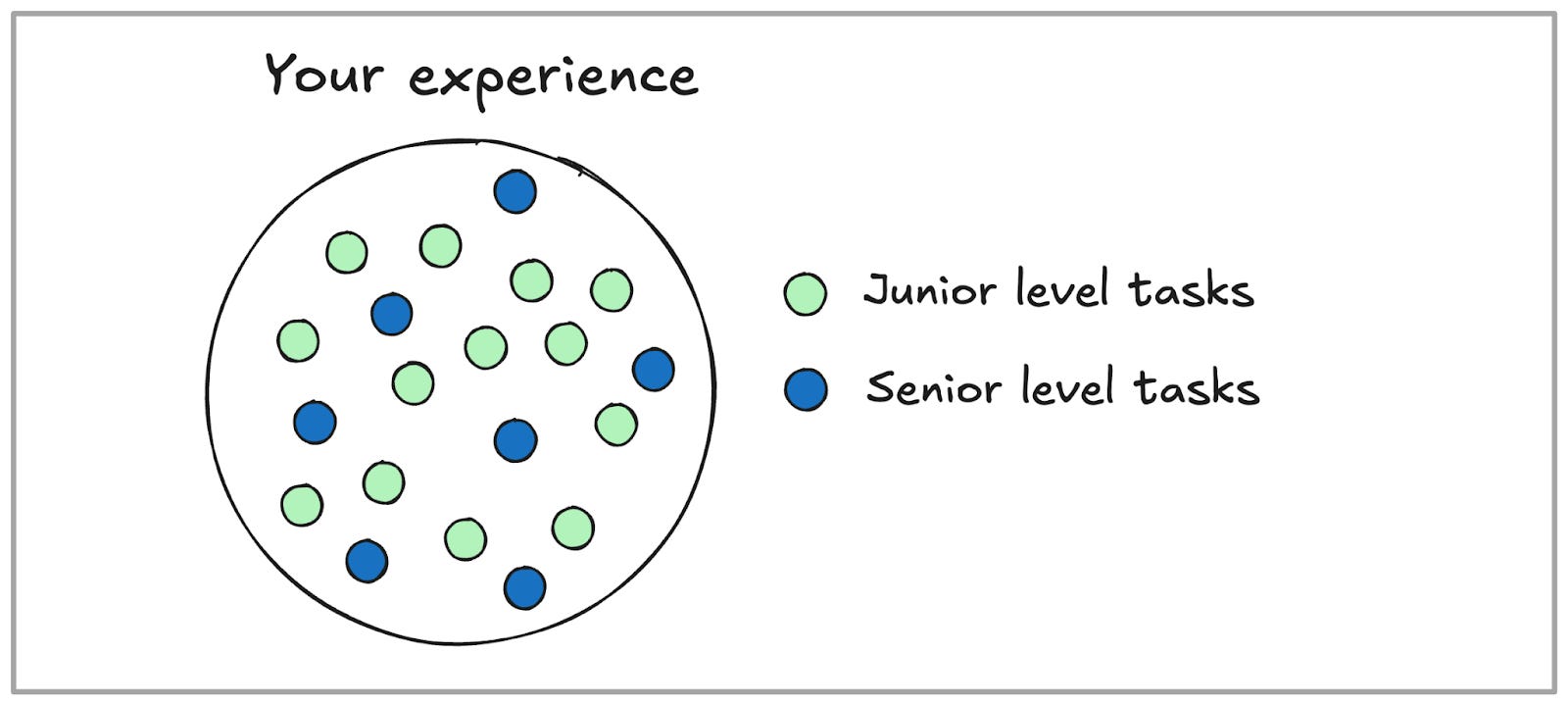
During an interview, the interviewer will make a perception about your seniority level based on the answers you provide.
I’ll focus on 3 main pillars of how you can enhance your answers to position yourself as a senior engineer:
Scope and Impact
Technical Depth and Complexity
Leadership and Collaboration
❌ What most people do
Here’s a common behavioral question engineers get asked:
Tell me about a time when you had to dive deep to find the root cause of an issue and resolve it.
Here is an example of an answer that an engineer would provide:
Our e-commerce site was loading slowly, especially during busy times.
I was asked to help speed it up.
I used Chrome DevTools to check the page performance and saw that the product images were taking too long to load. I compressed the images and implemented lazy loading for images below the fold.
This made the page load about 30% faster, and that significantly improved our end-customer experience.
The above answer is decent 🤷♂️
It follows the Situation-Task-Action-Result (STAR) format. It provides a clear picture to the interviewer along with the data points. It leaves enough room for the interviewer to ask follow-up questions.
However, this answer won't be enough to get you hired at a senior level. Here's why this answer misses the mark:
It doesn't convey the scale of the problem
It doesn’t showcase the depth of expertise required
It doesn’t mention leadership or collaboration with other team members and stakeholders.
Let's look at how to fix each of these issues individually.
Step 1: Situation
You should highlight the scope and impact early when covering the “Situation.” Beginning the answer with the scale and significance of the problem will ensure the interviewer does not perceive you as a junior engineer.
Here’s what highlighting the scope and impact in the “Situation” looks like:
❌ Before: Our e-commerce site was loading slowly, especially during busy times.
✅ After: Our e-commerce platform, which handles $10 million in monthly sales, was experiencing slow load times on product pages. It was causing a 5% drop in conversion rates.
You grab the interviewer’s attention because you framed the issue in terms of high business impact.
Instead of telling the interviewer the pages were loading slowly, you’re telling them that these pages handle $10 million in monthly sales. You also mention the 5% drop in conversion rates.
When you call out these business metrics, it showcases the scope and impact of the work you’re doing.
Step 2: Task and Action
Now, let’s update the “Task” and “Action” to show technical depth, leadership, and collaboration:
❌ Before: I was asked to help speed it up.
I used Chrome DevTools to check the page performance and saw that the product images were taking too long to load. I compressed the images and implemented lazy loading for images below the fold.
✅ After: Given the impact, I picked up the task to improve the page load time to under 2 seconds.
I led a comprehensive optimization effort, involving both front-end and back-end improvements.
The backend analysis revealed that database queries were also a significant factor in the slow load times. Working with the backend team, we implemented database indexing and query caching, reducing database response times by 50%.
On the front-end, I implemented image optimization, and we also introduced a content delivery network (CDN) to serve static assets globally, further reducing latency.
Now, you show the interviewer you have technical depth across the platform, not only a specific part of the application. It also shows them your leadership and collaboration by leading a cross-team optimization effort.
The “before” focused on junior-level tasks, like being assigned to fix a bug. The “after” focuses on the senior-level tasks like technical complexity, leadership, and collaboration. By focusing on the latter, you avoid getting downleveled.

Be cautious though—adding these details can be a double-edged sword. The interviewer will ask follow-up questions and if you get stuck answering them, you’ll lose the interviewer’s trust. If you can’t answer follow-up questions, it’s better to stick to the basic version, which will at least get you hired, although at a lower level.
Step 3: Results
Let's finish the answer by adding more details to the result.
❌ Before: This made the page load about 30% faster, and that significantly improved our end-customer experience.
✅ After: These combined efforts resulted in a 30% reduction in overall page load times, bringing us well under our 2-second target. The improvements led to a 15% increase in conversion rates, boosting monthly revenue by $1.5 million.
Now, this is a great answer with a lot of data points. It talks about the overall revenue impact of the task. Be ready to explain them in the follow-up questions.
If in your current role, you’re not aware of the business impact you’re making, ASK! Always try to understand WHY of a TASK you’re doing. Knowing the big picture helps you when you make a case for your promotion or when you interview.
The interviewer will try and peel the onion layer by layer to understand if you’re faking or have actually worked on the complex project at the level you claim.
Putting it all together
Using the 3 step framework to showcase your seniority, you can view using the STAR format like this:

Situation: The situation section should articulate the scope and business impact of the work you’re doing. It should reflect why a senior engineer's involvement is required in this scenario.
Task and Action: This section should showcase the complexity of the overall project and demonstrate your technical depth and expertise. This section should also highlight your leadership and cross-collaboration capabilities to be considered for a senior role.
Result: Tie the outcomes of your work back to the initial situation, reinforcing how your efforts delivered on the project's scope and business impact. Support it with relevant data and metrics.
In a follow-up article on my newsletter, I’ll extend this same example to showcase how to answer follow-up questions like:
Can you elaborate on the challenges you faced during the project?
How did you measure the success of your project?
📖 TL;DR
Senior engineers can navigate between overarching concepts and intricate details of each concept. If you’re preparing for an interview, showcase your ability to zoom in and out when you talk about your overall project experience.
To achieve this, start by playing the role of senior in your current project.
The three pillars serve as a framework for you to progress toward a senior role:
Scope and Impact
Technical Depth
Leadership and Collaboration
Use the template below to capture the pillars from projects you worked on and how you’ll answer questions in behavioral interviews.

As you prepare for your next behavioral interview, be intentional about structuring your answers and the details you provide. Your goal should be to accurately reflect your seniority level through your responses.
🙏 Thank you to Prasad
Thank you to Prasad for his insights on acing your behavioral interview and getting leveled correctly. The template he shared to help you prepare is also amazing 🤩
If you’d like to learn more from him, follow him on LinkedIn and check out his Substack, Behavioral OS for Techies.
This is the final “month of collaborations” guest post, but more guest posts will come in a few weeks with an exciting set of authors. Next week, I’ll round off our month of collaborations with a recap of all the key takeaways. It’ll be a lot of fun and learning!
📣 Shout-outs of the week
Failure is your best friend on The Software Engineer Weekly by Kevin Naughton Jr. — I love this article because I think a lot of people, including myself, can often be afraid of failure. Lately, I’ve been asking a lot of questions, but with the intention to use what I learn to grow and thrive in the future. Kevin captures the essence of that in his short post.
Backchannel Alignment on The Developing Dev by Ryan Peterman — Ryan tells you a secret to buy-in and influence, especially if you’re early in your career. When I learned it, it felt like a cheat code. Highly recommend checking it out!
Taha Hussain, the coach who helped me revamp my resume, is sharing his resume secrets this Tuesday and is giving an 85% discount to High Growth Engineer readers. You can check it out here and use the code JORDAN to get access for only $7. Note: I don’t get any cut if you join, I’m purely sharing it for the value to you.
Thank you for being a continued supporter, reader, and for your help in growing to 73k+ subscribers this week 🙏
Let’s get to 75k!!! We’re so close!
If you missed any past articles, check out Managing Up: 3 Things I Wish I Realized Sooner or Communicate like a Senior: How to Write Well.
P.S. Here are some other things that may interest you:
My LinkedIn: I write daily, actionable tips to become a better developer
My digital products: Get 100+ actionable insights and 50+ phrases used by the best leaders
Newsletter sponsorships: Feature your product to growth-minded engineers and leaders!
You can also hit the like ❤️ button at the bottom of this email to help support me or share this with a friend to get referral rewards. It helps me a ton!
Finally, leaving a review gives you a chance to “Spin the wheel” for rewards 🎁